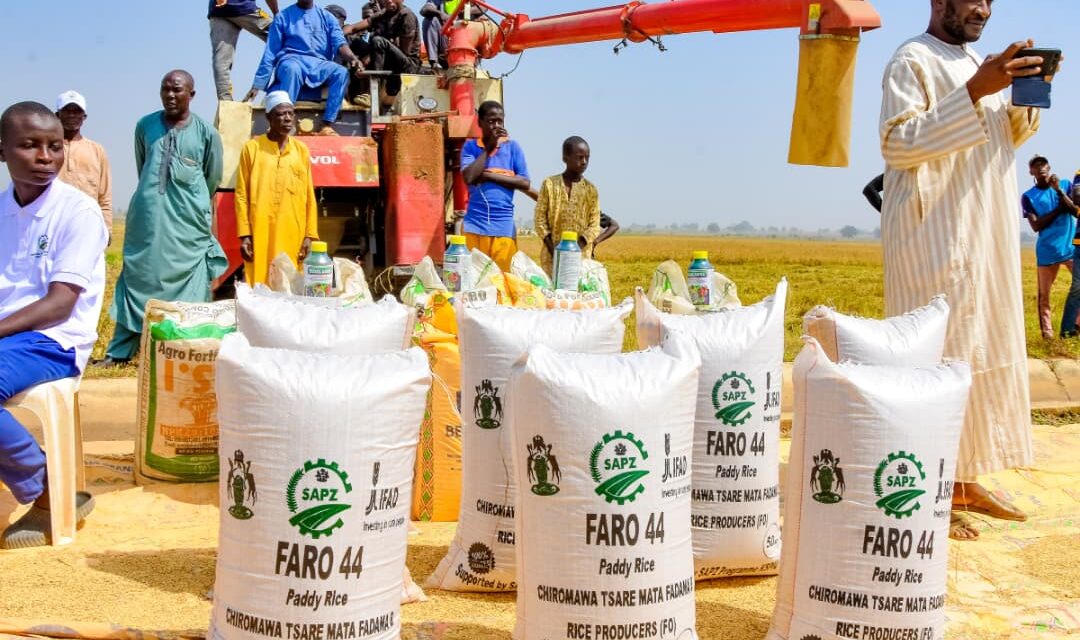
The Federal Government of Nigeria, in collaboration with the International Fund for Agricultural Development (IFAD), has concluded the Second Supervision Mission of the Special Agro-Industrial Processing Zones (SAPZ) Programme, featuring a Farmer Field Day held at the Chiromawa–Garin Babba Cluster in Garin Malam LGA, Kano State.
According to the statement, the supervision mission held from 26 November to 30 December 2025 aimed at reviewing programme progress, assessing field activities in Kano and Ogun States, and strengthening implementation measures to ensure the successful achievement of the Programme Development Objectives.
Speaking during the field visit, the National Programme Coordinator, Dr. Kabir Yusuf, said the mission team, which included IFAD consultants and federal officials from PCU/IERD and CPAT, State officials, visited Chiromawa Cluster to observe ongoing rice harvesting activities, interact with farmers, and assess yield performance and post-harvest practices.
Dr. Yusuf noted that the team also held a focused discussion with beneficiaries to understand their wet-season production processes, challenges encountered, and lessons learned from the 2025 climate-smart input distribution under the matching grant scheme.
Also speaking at the event, the Kano State Project Coordinator, Aminu Iliyasu, said the Field Day was organized to expose farmers to practical, science-based solutions capable of improving productivity and enhancing rural livelihoods. He described the event as a celebration of innovation, resilience, and knowledge exchange.
The statement further revealed that 9,870 units of climate-resilient agricultural inputs including FARO 44 improved seeds, Urea, NPK fertilizers, and insecticides were distributed to farmers across Selected LGAs during the 2025 wet season.
Farmers also received hands-on training on soil selection, seed dressing, nursery establishment, land preparation, timely transplanting, fertilizer management, weed control, Integrated Pest Management, and water regulation. Training extended to post-harvest practices such as harvesting at optimum maturity, paddy drying, and fumigation using phostoxin to reduce storage losses.
The support has significantly enhanced farmers’ capacity to increase yields and withstand climate pressures. Huwaila Shuaibu Ibrahim, a beneficiary who reported improved production from 20–25 bags per acre to about 40 bags after adopting improved practices and using FARO 44 seeds.
Dignitaries at the event included representatives of the Chairman of Garin Malam LGA, the Divisional Police Officer, the District Head, and the Chief Imam of the LGA.
The programme expressed optimism that continued support from government and partners will further strengthen agricultural value chains and improve livelihoods across the states.