
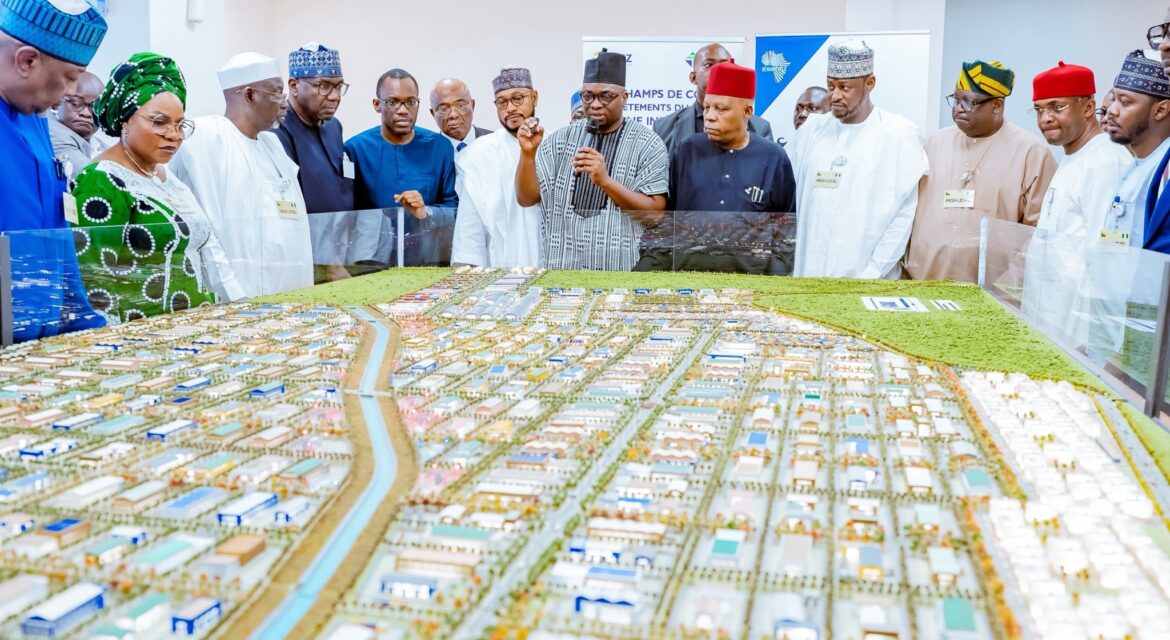
The Federal Government of Nigeria has reaffirmed its commitment to accelerating industrialisation and agricultural transformation through the Special Agro-Industrial Processing Zones (SAPZ) Programme following a high-level study visit to the Glo-Djigbé Industrial Zone (GDIZ) in the Republic of Benin.
The delegation was led by the Vice President of the Federal Republic of Nigeria, His Excellency Senator Kashim Shettima, GCON, and included the Honourable Minister of Agriculture and Food Security, Senator Abubakar Kyari, CON; the National Programme Coordinator of the SAPZ Programme, Dr. Kabir Yusuf; and the Governors of Kwara, Imo, Jigawa, Plateau, Katsina and Zamfara States.
The study visit forms part of the Federal Government’s efforts to strengthen the implementation of Nigeria’s Special Agro-Industrial Processing Zones Programme by learning from successful regional models that promote value addition, industrialisation, private sector investment and export competitiveness.
The Nigerian delegation was warmly received by the Republic of Benin’s Minister of Foreign Affairs, Ambassador Corinne Amori Brunet, and the Minister responsible for Industry, Trade and the Promotion of Private Investment, Mr. Olushegun Adjadi Bakari.
During the visit, the delegation received detailed briefings on the governance framework, operational model, investment incentives and production capacity of the Glo-Djigbé Industrial Zone. They also toured integrated textile manufacturing facilities, where locally produced cotton is transformed into yarn, fabrics and finished garments, as well as agro-processing facilities adding value to cashew and other agricultural commodities for both domestic and export markets.
The visit provided first-hand insight into how strategic government policies, quality infrastructure and strong public-private partnerships have positioned the GDIZ as a leading industrial hub in West Africa.
Speaking during the visit, Vice President Kashim Shettima stressed the urgent need for African countries to move beyond exporting raw materials and instead embrace industrialisation and value addition to unlock the continent’s economic potential.
“It is time for African nations to take their rightful place in controlling global resources and trade by maximizing the immense natural resources with which the continent has been endowed.”
The Vice President further reaffirmed President Bola Ahmed Tinubu’s unwavering commitment to inclusive national development, assuring that no region of Nigeria would be left behind in the country’s industrialisation drive under the Renewed Hope Agenda.
The National Programme Coordinator, Dr. Kabir Yusuf, noted that the lessons from the GDIZ would contribute significantly to strengthening the implementation of the SAPZ Programme across participating states by promoting efficient agro-industrial development, investment mobilisation, value chain integration and sustainable job creation.
Nigeria’s Special Agro-Industrial Processing Zones Programme is a flagship initiative of the Federal Government, implemented by the Federal Ministry of Agriculture and Food Security with support from development partners, including the African Development Bank (AfDB), the International Fund for Agricultural Development (IFAD) and the Islamic Development Bank (IsDB). The programme seeks to transform rural economies through modern agro-industrial infrastructure, increased agricultural productivity, private sector investment and inclusive economic growth.
Shehu Babangida
National Knowledge Management and Communication Expert
SAPZNigeria.